Cultural India

Cultural India Home » People » History » National Anthem » National Animal » National Tree » Fairs & Festivals
Physical Features » National Emblems » National Bird » National Fruit » Religions » Languages
National Flag » National Flower » Air Line Ticketing » Map of India » Travellers Tools
---------------------------------------------------------------------------------------------------------------------------------------------------------------------------------------------------------------------------------
Religions
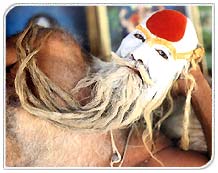 HINDUISM
The Hindu religion had its origin in the concepts of the early Aryans who came to India more than 4,000 years ago. It is not merely a religion but also philosophy and a way of life. Hinduism does not originate in the teachings of any one prophet or holy book. It respects other religions and does not attempt to seek converts. It teaches the immortality of the human soul and three principal paths to ultimate union of the individual soul with the all-pervasive spirit. The essence of Hindu faith is embodied in the Lord's Song, the Bhagavad Gita: "He who considers this (self) as a slayer or lie who thinks that this (self) is slain, neither knows the Truth. For it does not slay, nor is it slain. This (self) is unborn, eternal, changeless, ancient, it is never destroyed even when the body is destroyed".
JAINISM AND BUDDHISM
In the sixth century before Christ, Mahavira propagated Jainism. Its message was asceticism, austerity and non-violence. At about the same time, Buddhism came into being Gautama Buddha, a prince, renounced the world and gained enlightenment. He preached that 'Nirvana' was to be attained through the conquest of self. Buddha's teachings in time spread to China and some other countries of South-East Asia.
ISLAM
Arab traders brought Islam to South India in the seventh century. After them came the Afghan the seventh century. After them came the Afghans and the Moghuls, among whom the most enlightens was the Emperor Akbar. Akbar almost succeeded in founding a new religion Din-e-Elahi, based on both Hinduism and Islam, but it found few adherents. Islam has flourished in India through the centuries. Muslim citizens have occupied some of the highest positions in the country since independence in 1947.
SIKHISM
Guru Nanak, the founder of Sikhism in the 15-century, stressed the unity of God and the The Sisganj Gurudwara in Delhi, an important Sikh shrine brotherhood of man. Sikhism, with its affirmation of as the one supreme truth and its ideals of discipline and spiritual striving, soon won many followers. It was perhaps possible only in this hospitable land that two religions as diverse as Hinduism and Islam could come could come together in a third, namely Sikhism.
 CHRISTIANITY
Christianity reached India not long after Christ's own lifetime, with the arrival of St. Thomas, the Apostle. The Syrian Christian Church in the south traces its roots to the visit of St. Thomas. With the arrival of St. Francis Xavier in 1542 the Roman Catholic faith was established in India. Today Christians of several denominations practice their faith freely.
ZOROASTRIANISM
In the days of the old Persian Empire, Zoroastrianism was the dominant religion in West Asia, and in the form of Mithraisn it spread over vast areas of the Roman Empire, as far as Britain. After the Islamic conquest of Iran, a few intrepid Zoroastrians left their homeland and sought refuge in India. The first group is said to have reached Diu in about 766 A.D. The total number of Zoroastrians probably does not exceed 130,000. With the exception of some 10,000 in Iran, almost all of them live in India, the vast majority concentrated in Mumbai. The Parsees excel in industry and commerce, and contribute richly to the intellectual and artistic life of the nation.
JUDAISM
Jewish contact with the Malabar Coast in Kerala dates back to 973 BC when King Solomon's merchant fleet began trading for spices and other fabled treasures. Scholars say that the Jews first settled in Cranganore, soon after the Babylonian onquest of Judea in 586 BC. The immigrants were well received and a Hindu king granted to Joseph Rabban, a Jewish leader, a title and a principality.
Physical Features » National Emblems » National Bird » National Fruit » Religions » Languages
National Flag » National Flower » Air Line Ticketing » Map of India » Travellers Tools